

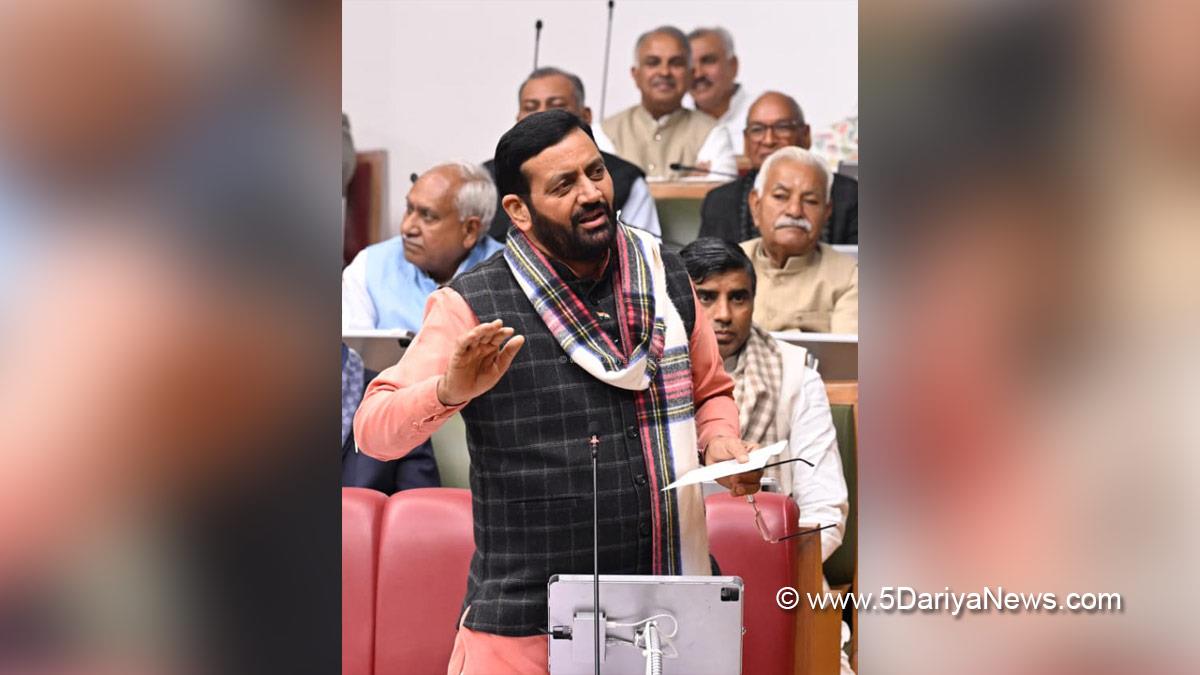
On the second day of the Winter Session of the Haryana Vidhan Sabha, Seven Bills were tabled including, the Haryana Technical Education Guest Faculty (Security of Service) Amendment Bill, 2025; Haryana Housing Board (Amendment) Bill, 2025; Haryana Private Universities (Amendment) Bill, 2025; Haryana Abadi Deh (Vesting, Recording and Resolving of Ownership Rights) Bill, 2025; Haryana Shops and Commercial Establishments (Amendment) Bill, 2025; Haryana Scheduled Roads and Controlled Areas Restriction of Unregulated Development (Amendment) Bill, 2025 and the Haryana Public Trust Provisions Amendment Bill, 2025.
In addition, eight bills were passed after discussion. These include the Haryana Shri Mata Mansa Devi Shrine (Amendment) Bill, 2025; Haryana Shri Mata Sheetla Devi Shrine (Amendment) Bill, 2025; Haryana Shri Mata Bhimeshwari Devi Mandir (Ashram), Beri Shrine (Amendment) Bill, 2025; the Haryana Antrarashtriya Gita Jyanti Mela Authority (Amendment) Bill, 2025, The Haryana Shri Kapal Mochan, Shri Badri Narain, Shri Mantra Devi and Shri Kedar Nath Shrine (Amendment) Bill, 2025, The Haryana Municipal Corporation (Amendment) Bill, 2025, The Haryana Panchayati Raj (Second Amendment) Bill, 2025 and The Haryana Municipal Bill, 2025.
Haryana Shri Mata Mansa Devi Shrine (Amendment) Bill, 2025
The Haryana Shri Mata Mansa Devi Shrine (Amendment) Bill, 2025 was passed to amend the Haryana Shri Mata Mansa Devi Shrine Act, 1991. The sub-section (b) of Section 8 of the Act disqualifies any person who is “of unsound mind and stands so declared by a competent Court or is a deaf, mute or is suffering from contagious leprosy or any virulent contagious disease” from being nominated as a Member of the Board.
The Act was enacted in the year 1991, in compliance of Supreme Court directions dated May 07, 2025 passed in W.P. (c) No. 83 of 2010 titled Federation of Lepy. Organ. (FOLO) Vs. Union of India and in view with the change in the social structure where now physically challenged and terminally ill persons command great acceptability and respect in the society, to continue with the said provision appears unwarranted.
Sence, it is necessary to carry out amendment in the Haryana Shri Mata Mansa Devi Shrine Act, 1991 (14 of 1991) by way of enacting the Haryana Shri Mata Mansa Devi Shrine (Amendment) Bill, 2025.
Haryana Shri Mata Sheetla Devi Shrine (Amendment) Bill, 2025
The Haryana Shri Mata Sheetla Devi Shrine (Amendment) Bill, 2025 was passed to amend the Haryana Shri Mata Sheetla Devi Shrine Act, 1991. The sub-section (b) of Section 8 of the Act disqualifies any person who is “of unsound mind and stands so declared by a competent Court or is a deaf, mute or is suffering from contagious leprosy or any virulent contagious disease” from being nominated as a Member of the Board.
The Act was enacted in the year 1991 in compliance of Supreme Court directions dated May 07, 2025 passed in W.P. (c) No. 83 of 2010 titled Federation of Lepy. Organ. (FOLO) Vs. Union of India and with the change in the social structure where now physically challenged and terminally ill persons command great acceptability and respect in the society, to continue with the said provision appears unwarranted.
Hence, it is necessary to carry out amendment in the Haryana Shri Mata Sheetla Devi Shrine Act, 1991 (10 of 1992) by way of enacting the Haryana Shri Mata Sheetla Devi Shrine (Amendment) Bill, 2025.
Haryana Shree Mata Bhimeshwari Devi Mandir (Ashram), Beri Shrine (Amendment) Bill, 2025
The Haryana Shree Mata Bhimeshwari Devi Mandir (Ashram), Beri Shrine (Amendment) Bill, 2025 was passed to amend the Haryana Shree Mata Bhimeshwari Devi Mandir (Ashram), Beri Shrine Act, 2022. The clause (b) of Section 8 of the Act disqualifies any person who is “of unsound mind and stands so declared by a competent Court or is a deaf, mute or is suffering from contagious leprosy or any virulent contagious disease” from being nominated as a Member of the Board.
The Act was enacted in the year 2025. In compliance of Supreme Court directions dated May 7, 2025, passed in W.P. (c) No. 83 of 2010 titled Federation of Lepy. Organ. (FOLO) Vs. Union of India and in view with the change in the social structure where now physically challenged and terminally ill persons command great acceptability and respect in the society, to continue with the said provision appears unwarranted.
Hence, it is necessary to carry out amendment in the Haryana Shree Mata Bhimeshwari Devi Mandir (Ashram), Beri Shrine Act, 2022 (25 of 2025) by way of enacting the Haryana Shree Mata Bhimeshwari Devi Mandir (Ashram), Beri Shrine (Amendment) Bill, 2025.
The Haryana Antrarashtriya Gita Jyanti Mela Authority (Amendment) Bill, 2025
Haryana Antrarashtriya Gita Jyanti Mela Authority (Amendment) Bill, 2025 was passed to amend the Haryana Antrarashtriya Gita Jyanti Mela Authority Act, 2024. The sub-section (b) of Section 6 of the Act disqualifies any person who is “a deaf, mute or is suffering from contagious leprosy or any virulent contagious disease” from being nominated as a Member of the Board.
The Act was enacted in the year 2010 in compliance of Supreme Court directions dated May 7, 2025, passed in W.P. (c) No. 83 of 2010 titled Federation of Lepy. Organ. (FOLO) Vs. Union of India and with the change in social structure where now physically challenged and terminally ill persons command great acceptability and respect in the society, to continue with the said provision appears unwarranted.
Hence, it is necessary to carry out amendment in the Haryana Antrarashtriya Gita Jyanti Mela Authority Act, 2024 (7 of 2024) by way of enacting the Haryana Antrarashtriya Gita Jyanti Mela Authority (Amendment) Bill, 2025.
Haryana Shri Kapal Mochan, Shri Badri Narain, Shri Mantra Devi and Shri Kedar Nath Shrines (Amendment) Bill, 2025
The Haryana Shri Kapal Mochan, Shri Badri Narain, Shri Mantra Devi and Shri Kedar Nath Shrine (Amendment) Act, 2025 was passed to amend the Haryana Shri Kapal Mochan, Shri Badri Narian, Shri Mantra Devi and Shri Kedar Nath Shrine Act, 2009. The sub-section (c) of Section 8 of the Act disqualifies any person who is “a deaf, mute or is suffering from contagious leprosy or any virulent contagious disease” from being nominated as a Member of the Board.
The Act was enacted in the year 2010 in compliance of Supreme Court directions dated May 7, 2025, passed in W.P. (c) No. 83 of 2010 titled Federation of Lepy. Organ. (FOLO) Vs. Union of India and with the change in social structure where now physically challenged and terminally ill persons command great acceptability and respect in the society, to continue with the said provision appears unwarranted.
Hence, it is necessary to carry out amendment in the Haryana Shri Kapal Mochan, Shri Badri Narain, Shri Mantra Devi and Shri Kedar Nath Shrine Act, 2009 (12 of 2010) by way of enacting the Haryana Shri Kapal Mochan, Shri Badri Narain, Shri Mantra Devi and Shri Kedar Nath Shrine (Amendment) Bill, 2025.
Haryana Municipal Corporation (Amendment) Bill, 2025
The Haryana Municipal Corporation (Amendment) Bill, 2025 was passed to amend the Haryana Municipal Corporation Act, 1994. The sub-clause (a) of clause (8) of section 2 of the Act defines the dangerous disease means cholera, plague, chicken-pox, small-pox, tuberculosis, leprosy, enteric fever, cerebrospinal, meningitis and diphtheria.
The Act was enacted in the year 1994, in compliance of Supreme Court directions dated May 7, 2025, passed in W.P. (c) No. 83 of 2010 titled Federation of Lepy. Organ. (FOLO) Vs. Union of India and in view with the change in the social structure where now physically challenged and terminally ill persons command great acceptability and respect in the society, to continue with the said provision appears great acceptability and respect in the society, to continue with the said provision appears unwarranted.
Hence, it is necessary to carry out amendment in the Haryana Municipal Corporation Act, 1994 (16 of 1994) by way of enacting the Haryana Municipal Corporation (Amendment) Bill, 2025.
Haryana Panchayati Raj (Second Amendment) Bill, 2025
The Haryana Panchayati Raj (Second Amendment) Bill, 2025 was passed to amend the Haryana Panchayati Raj Act, 1994. As per existing provision, approval of the eligibility of identified beneficiaries of any government scheme and preparation of Gram Panchayat Development Plan are done by the Gram Sabha in its meeting with a quorum of one-tenth of its members or three hundred members, whichever is less, whereas to consider and approve the identified beneficiaries of any government scheme or to prepare a Gram Panchayat Development Plan, it is necessary to ensure presence of more members of Gram Sabha in its meeting to bring more transparency in the process. Approval of the eligibility of identified beneficiaries of Mukhya Mantri Gramin Basti Yojana by Gram Sabha is in process.
Haryana Municipal Bill, 2025
The Haryana Municipal Bodies Bill, 2025 was introduced to consolidate and amend laws relating to municipalities and to provide for the establishment of Municipalities in the State of Haryana so as to give them wider powers in the management of municipal affairs.
The Constitution of India has entrusted the responsibility of local administration to the municipalities in urban areas and assigned the role to the municipalities as a third tier of the governance on the pattern of Central and State Governments. Further, the Constitution of India has envisaged a hierarchy in the municipalities on the basis of population criteria.
Accordingly, municipalities in the State of Haryana are constituted under three categories, i.e., Municipal Corporations, Municipal Councils and Municipal Committees, mainly on the basis of population criteria and other factors such as population density, non-agricultural activities, revenue generation, etc. However, the municipalities existing/established at the district headquarters are designated as Municipal Councils, irrespective of their population.
Municipal Councils and Municipal Committees are governed under the provisions of the Haryana Municipal Act, 1973 (24 of 1973) whereas Municipal Corporations are governed under the provisions of the Haryana Municipal Corporation Act, 1994 (16 of 1994).
The Ministry of Housing and Urban Affairs, Government of India had circulated the Model Municipal Law in the year 2003 to bring uniformity in the municipal laws across the country, simplifying the municipal bye-laws, introducing reforms in financial management and accounting systems as well as enhancing internal resource generation capacity of the municipalities.
The level and quality of delivery of municipal services to the residents needs to be in consonance within all the three categories of municipalities and cannot be subjected to vagaries of financial hardship and functional uncertainties. Urban Local Bodies Department is the single supervising department for all three categories of municipalities.
Since the enactment of the Haryana Municipal Act, 1973 (24 of 1973) and the Haryana Municipal Corporation Act, 1994 (16 of 1994), more than fifty amendments have been carried out in both the existing municipal Acts. Further, the department has to issue separate notifications under both these municipal Acts for similar matters/purposes, such as notifications related to the assessment of property tax, rules and regulations regarding licences, fixing of rates/fees related to advertisements, development charges etc.
Such exercise results in unnecessary duplication of efforts, waste of time and is causing confusion among the public as well as departmental officials.The existence of two separate set of Service Rules framed under both the municipal Acts has also led to ambiguities in the matters related to transfers, promotions and fixation of seniority lists of municipal staff. This often results in avoidable litigation and defeats the objective of efficient deployment of personnel for better productivity.
There are ten States in the country namely Bihar, Rajasthan, Kerala, Jharkhand, Tripura, Manipur, Meghalaya, Mizoram, Nagaland and Sikkim where all the categories of municipalities are governed under a single municipal Act. In order to impart certainty, continuity and strength to the municipalities in the State as envisaged under the provisions of the Constitution (Seventy-Fourth) Amendment Act, 1992 and to bring greater transparency and improved governance, Urban Local Bodies Department proposes to enact a single consolidated Act namely the Haryana Municipal Bill, 2025 which will be applicable uniformly to all the municipalities of the State.
Some additional provisions have also been incorporated in the proposed Bill aiming to ensure that – Municipalities have been empowered to determine the taxes and fees related to property tax, development tax and fees, garbage fee, advertising fee, water and sewerage fee etc., between minimum and maximum rates prescribed by the government.
Allowing elected representatives of the municipalities to attend the meetings through electronic mode and enabling the municipalities to pass resolutions through circulation without physical attendance. Provisions have been made for effective planning of urban transport to improve traffic management and establishment of urban forestry for maintaining ecosystem services as well as lush green areas within municipal areas.
Framing of common service rules for all the municipal employees, which will reduce the litigations to a large extent, and Appointment of municipal magistrate for trial of municipal offences.

Comments are closed.